
Parole vs Probation in Grayson County
Parole and probation both allow a person to live outside a jail or prison, but they begin in different ways. A Grayson County court orders probation, which Texas usually calls community supervision. The Grayson County Community Supervision and Corrections Department, or CSCD, administers it. Parole follows confinement in a Texas Department of Criminal Justice institution and is authorized through the Texas Board of Pardons and Paroles. TDCJ's Parole Division then supervises the releasee. Mandatory supervision is another TDCJ release form and is not county probation.
The source of the sentence decides where to verify it. Someone leaving Grayson County Jail under a probation order should have a matching court disposition and CSCD record. Someone leaving state prison on parole or mandatory supervision may remain in the TDCJ offender system because the sentence continues after physical release. A full discharge ends the sentence and supervision.
| Point | Parole | Probation |
|---|---|---|
| How it starts | Release from TDCJ under Board authority | Order entered by a Grayson County court |
| Local administrator | TDCJ Parole Division, Sherman District Parole Office | Grayson County CSCD |
| Best proof | TDCJ status, release date, and office assignment | Court order and CSCD confirmation |
| How it ends | TDCJ discharge or other lawful termination | Court discharge or expiration of the supervision term |
- Releasee
- A person outside prison while serving part of a sentence on parole or mandatory supervision.
- Discharge
- Completion of incarceration and any parole, mandatory supervision, or community supervision.
- Absconder
- A supervised person who fails to report and cannot be found for continued supervision.
How to Verify Grayson County Post-Release Supervision
Verification should follow the custody path, not a broad name search. A same-name result does not establish identity, and a favorable parole vote does not prove the person has left prison. TDCJ may approve release in the future, require a program first, or later withdraw approval when new facts arise. Confirm the actual status shown on the matching record.
- Identify whether the person left Grayson County Jail under a local court order or left a TDCJ prison.
- For state parole, use the TDCJ Inmate Search. Search by TDCJ number or SID when possible, then compare name and identity details.
- Open the details and Parole Review Information. Separate eligibility, a Board vote, a scheduled date, actual release status, and discharge.
- Before a release vote, call the Board status line at 844-512-0461. After a vote, call TDCJ release status at 512-406-5202. General inmate information is available at 936-295-6371 or 800-535-0283.
- For probation, read the Grayson County criminal case and contact CSCD. A TDCJ parole search is not a complete probation search.
- Save the release type, release date, present supervision status, assigned office, and later discharge date as separate facts.
Those steps also prevent a transfer from being called a release. Grayson County has no TDCJ unit, so a local defendant sentenced to state prison can disappear from the county jail while still confined elsewhere in Texas. The statewide TDCJ record becomes controlling after that transfer.
Grayson County Supervising Office
TDCJ's county cross-reference assigns Grayson County parole cases to Sherman in Region II. Office assignment corroborates where state supervision is handled, but the directory is not a public roll of every person supervised there. Confirm assignment on the individual record or with the office.
2931 Fallon Drive
Sherman, TX 75090
Phone: 903-868-2616
Fax: 903-893-1049
The successful TDCJ directory capture shows the local office information at its official source.
View the Sherman Region II directory before using the captured page below.
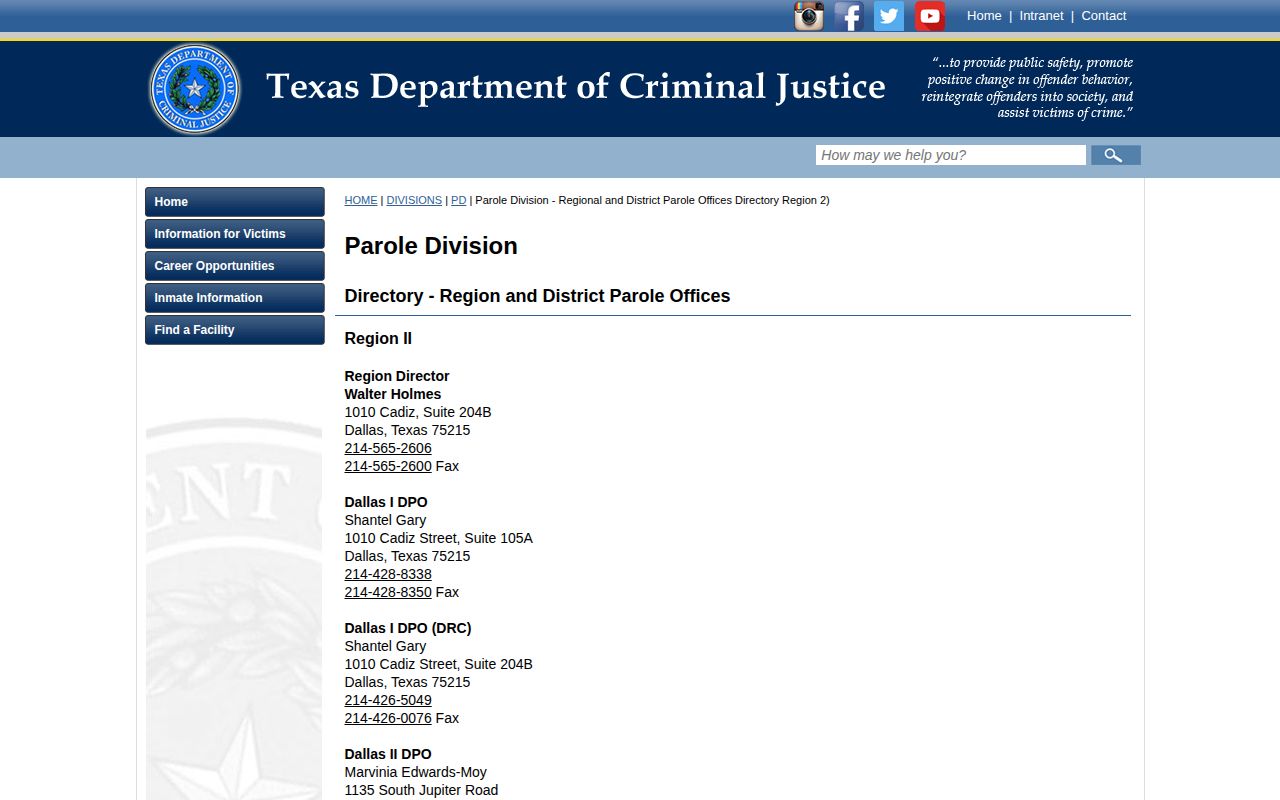
The directory identifies the state parole contact, not the Grayson County probation department.
Conditions, Violations, and Absconders
Conditions are enforceable rules attached to release. They can require reporting, approved residence, treatment, travel limits, or compliance with other instructions in the certificate or court order. The exact terms belong to the person's official record. A missed appointment can lead to action, but it should not be publicly labeled a violation or warrant without confirmation.
An absconder remains subject to supervision. The term does not mean the sentence vanished. TDCJ policy permits release of certain warrant number and date information on request, along with parole status, release dates, and the supervising officer's name. A revoked parole can return a releasee to custody, so the old release date stays historically true while present status changes. For probation, the Grayson County court docket can show a motion, hearing, revocation, or discharge.
Texas DPS wanted lists are selective, not complete lists of parole or probation absconders. A blank wanted-list search proves little. Use the agency that holds the supervision record.
How Grayson County Supervision Ends
Release and discharge are separate milestones. Physical release ends confinement at that facility. Discharge ends the sentence and supervision. A person on parole has left prison, yet still owes duties under the sentence. When TDCJ shows a discharge date, it marks completion of incarceration, parole, mandatory supervision, or community supervision as applicable to that record.
Grayson County CSCD explains that early discharge from probation is limited and depends on court action. Completion should be confirmed from the court or CSCD rather than inferred from the last planned report date. For a reliable timeline, pair the court disposition with the jail release event for probation, or pair the TDCJ release event with later discharge for parole. The county-wide search and custody-record routes are explained on the Grayson County released inmates home page.
Note: A supervision end date does not replace the earlier jail or prison release record.
Grayson Probation Record Sources
The Grayson County CSCD FAQ draws the local line clearly: probation is ordered by a court, while parole follows prison release. The court case is therefore the durable source for the term imposed, any modification, a violation proceeding, and the final discharge. County Court at Law records cover misdemeanors; felony matters belong with the District Clerk.
The CSCD capture preserves the county's own distinction and its discussion of reporting and early discharge.
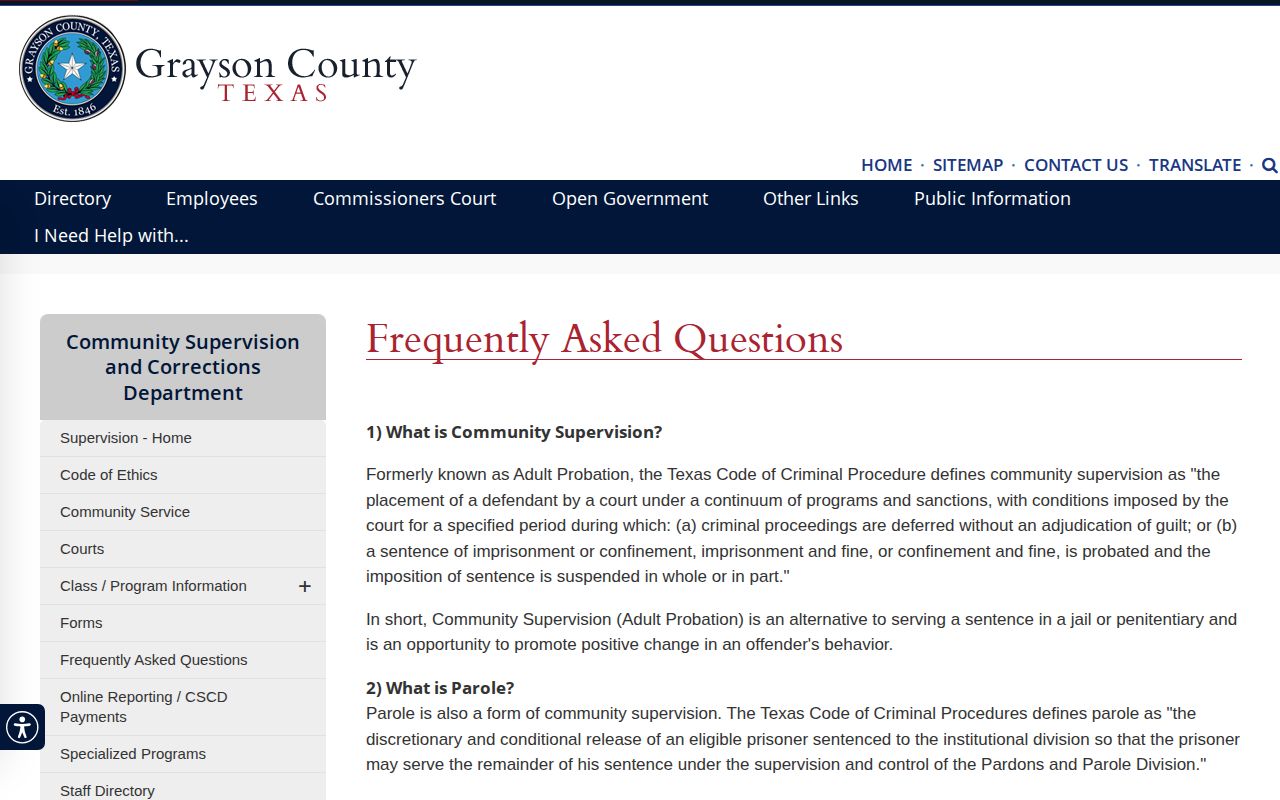
That local source should be read with the actual judgment instead of treated as a person-specific lookup.
Grayson Supervision Notification Layers
County-jail notifications and state post-release notifications are different services. Texas moved county VINE activity to IVSS-Counties in 2025. That county system can report custody and court event changes when the agency and person are covered. It should not be confused with TDCJ IVSS, which covers state custody, parole, and mandatory supervision.
TDCJ IVSS has its own registration controls. Its user guide documents an email-confirmation link and a four-digit telephone PIN. Those steps belong to the state post-conviction service. They should not be copied into current Grayson County IVSS-Counties instructions unless that portal itself asks for them. TDCJ Victim Services can assist at 800-848-4284 or victim.svc@tdcj.texas.gov.
Notification confirms the event named in the notice. It does not replace a release certificate, court order, or discharge record. Save the notice date and issuing system, then reconcile it with the custodian's record.
Grayson Parole Record Fields
TDCJ parole policy identifies public fields that can resolve many supervision questions without speculation. Available items can include the supervising parole officer's name, aliases and physical descriptors, offense and sentence information, court and cause number, sentence start and length, parole eligibility, parole release, mandatory release, discharge dates, current parole or mandatory-supervision status, and warrant number or date information.
A focused request should use the full name with a TDCJ or SID number. If neither number is known, full name and date of birth can help distinguish the record. Ask only for the fields needed to establish the chronology. The physical release date, release type, supervision assignment, and discharge date are four distinct facts. Keeping them distinct guards against describing a fully discharged person as still supervised.
TDCJ Public Information Act channels do not replace local probation records. TDCJ expressly directs adult community-supervision questions to the local probation department. A county judgment can establish probation even when no TDCJ offender record exists.
Grayson Probation Court Path
Grayson County divides criminal files by offense level. The County Clerk maintains misdemeanor records for County Courts at Law Nos. 1 and 2. The District Clerk handles felonies. Search the proper office for the judgment, conditions, later modifications, violation filings, revocation orders, and discharge. Searching only one clerk can produce a false absence.
A probation disposition can follow release from the Grayson County Jail, but the disposition does not state the exact time the jail finished processing release. Match it to the sheriff's release entry when physical timing matters. Likewise, a motion to revoke is an allegation until the court acts. Read the later order before describing the supervision outcome.
Community supervision can end by completion, lawful early discharge, revocation, or another court action reflected in the file. The county CSCD FAQ notes that early discharge is limited and court-controlled. A planned end date or last office visit is not enough. Request the final order when the distinction affects a release chronology.
Grayson Parole Vote Status
A Texas parole decision has several stages. Before the Board votes, the TDCJ offender details may show an eligibility or review date. Eligibility means the file can be considered. It is not a promise of release. The Board reviews files individually and can approve, deny, defer, or require a program before release. Texas does not hold a formal public parole hearing for each case, so there is no ordinary hearing calendar to use as proof.
Approval codes also need context. FI-1 means release when eligible, while FI-2 names a future month and year. Other approval votes can require a treatment or rehabilitation program. RMS authorizes release to mandatory supervision. Staff must still prepare and audit a release certificate. TDCJ then may post a scheduled release date and location, both subject to change. Confirm the later active parole or mandatory-supervision status before stating that prison custody ended.
Denial can set another review date or require more of the sentence to be served. A denial does not erase a past release, and a later revocation does not make the original prison-release date false. Build the chronology from each dated event rather than reducing the record to “approved” or “denied.”
Grayson Mandatory Supervision Records
Mandatory supervision is not probation. It is a TDCJ release form in which eligible calendar time and applicable good-conduct time reach the sentence, subject to the governing Texas rules. For many applicable post-1996 cases, the Board conducts discretionary mandatory-supervision review. Government Code section 508.149 excludes listed offenses and permits denial under the statutory test.
The TDCJ record should identify whether a person is on parole or mandatory supervision. Both mean the person has left institutional confinement while the sentence continues in the community. The Sherman District Parole Office may supervise either type when assignment is local. Do not infer the release type from the office address alone.
When the live TDCJ search no longer returns a fully discharged person, request historical incarceration and discharge information. The release date shows when prison confinement ended. The discharge date shows when the remaining sentence and supervision ended. The court judgment remains useful for sentence context, but it does not replace TDCJ's custody and supervision dates.
Grayson Probation Violation Records
The Grayson County CSCD FAQ explains that violations can lead to sanctions or court action. A filed allegation is not a final finding. Read the docket for the motion, hearing, and signed order. The judge may continue, modify, or revoke community supervision under the law and facts of the case.
If probation is revoked and the person returns to jail or enters TDCJ, start a new custody segment. The earlier jail release remains part of the history, while the new booking or prison record establishes present confinement. This is why a single roster check cannot describe the whole supervision path.
For a person who completes probation, request the discharge or termination order when available. Do not infer completion from a missing CSCD result, lack of a public warrant, or an expected end date. Official court action supplies the durable proof.